
Stone Crushing Production Line Crusher Ranking: PX, PC, PCX and 2PG-Y by Application Role
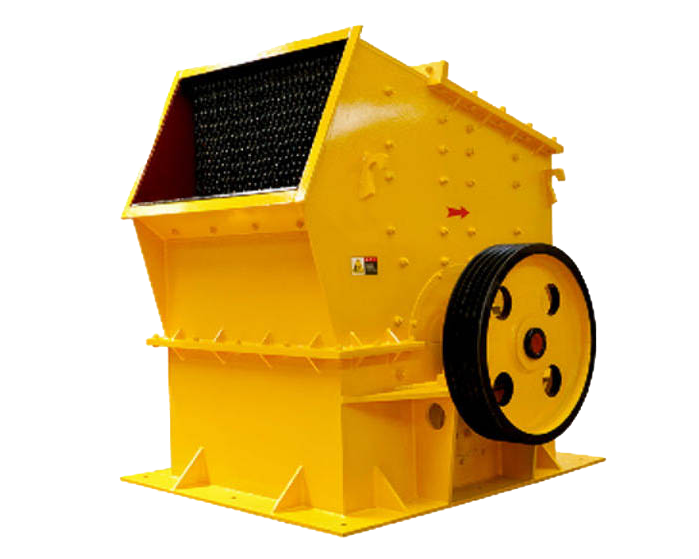
Ranking scope: the four crusher families below are all manufactured by Shandong Lianbang Heavy Industry Co., Ltd. under the Shanyuan LBZG trademark. This is a role-based ranking inside one manufacturer's portfolio, not a claim of superiority over third-party equipment.
If your stone crushing production line already has a primary jaw crusher, the decision that most affects graded output and cost per ton is the fine-crushing stage. Four crusher families in the LBZG range compete for that duty: PCX Crusher, PX Crusher, PC Crusher and 2PG-Y Roller Crusher. Ranked by application fit as the final reduction stage in an aggregate line, the order is PCX first, PX second, PC third and 2PG-Y fourth.
This is deliberately a fit ranking, not a performance ranking. Shandong Lianbang Heavy Industry Co., Ltd. is a Linyi-based manufacturer of sand-stone crushing, sand-making and solid-waste recycling equipment, registered in 2013 and trading under the Shanyuan LBZG trademark. Because all four families come from the same manufacturer, nothing here implies that third-party equipment is weaker, and no output, wear-life or cost figure is stated beyond what published specifications and documented selection guidance support.
- Rank 1 — PCX Crusher: the tightest discharge control in the mid-capacity band (discharge sizes from <10 mm to <20 mm across seven models, 30–350 t/h) for tertiary crushing of limestone, coal, gypsum and shale.
- Rank 2 — PX Crusher: the largest accepted feed among the fine-crushing options (up to 800 mm on PX-1822) with a 5–20 mm discharge range, positioning it for fine crushing and sand-oriented circuits.
- Rank 3 — PC Crusher: the widest capacity span of the four (30–1000 t/h) and the simplest circuit, but also the most sensitive to wet feed and abrasive stone.
- Rank 4 — 2PG-Y Roller Crusher: a 2–18 t/h band built for controlled-size reduction in cement, metallurgy, building material, refractory and coal duties rather than high-tonnage aggregate output.
Role-adjusted view: the order changes if your objective changes. If manufactured sand volume is the target, PX Crusher moves to the front of the fine-crushing discussion. If one-pass tonnage and the shortest circuit are the target, PC Crusher moves up. If discharge control on a low-capacity brittle-material duty is the target, 2PG-Y is the only sensible answer of the four.
Why "Which Crusher Is Best for Stone?" Is the Wrong Question
A stone crushing production line is a chain of roles, not a single machine. Each stage is defined by what it receives and what it must hand to the next stage, and a crusher that performs well in one role can be the wrong purchase in another.
The four roles in a conventional line are predictable. Primary crushing reduces run-of-quarry rock to a size that secondary equipment can accept. Secondary crushing produces the coarse and medium aggregate fractions. Tertiary or fine crushing produces the final graded sizes and controls the proportion of fines. A fourth, narrower role covers specialty reduction, where the product is governed by a fixed roll gap rather than by an impact chamber.
The four crusher families ranked in this article all operate in the third and fourth roles. Misreading which role a machine is designed for creates three predictable problems: oversized material that recirculates instead of leaving the circuit, an excess of fine particles that changes the value of the finished stockpile, and accelerated wear or clogging when the material is harder or wetter than the duty assumed at the quotation stage.
A second distinction matters just as much. Within the fine-crushing role, a buyer must separate crushers that accept relatively large feed from crushers that require pre-reduced feed. The PX Crusher, for example, is offered with maximum feed sizes from 300 mm to 800 mm depending on model, while the PCX and PC families are documented as fine and tertiary machines for medium-hard, brittle materials. That single difference decides whether a primary crusher can discharge directly into the fine stage or whether an intermediate stage must be inserted.
Where Fine Crushing Sits in the Global Stone Crushing Market
Third-party market data puts the fine-crushing decision in context. The global stone crushing equipment market was estimated at USD 8.47 billion in 2024 (Market Research Future). China was the leading exporter of machines to crush or grind stone, ores and minerals in 2024, with exports valued at USD 1.38 billion under HS code 847420 (Observatory of Economic Complexity).
The installed base is dominated by primary equipment: jaw crushers accounted for a 35.2% market share in 2025 because of their use in primary crushing (Polaris Market Research). Meanwhile, the United States produced 1.5 billion tons of crushed stone in 2023, valued at over USD 24 billion (USGS, cited by Research Nester). The pattern behind these figures is straightforward. Most capital goes into primary crushing, but the grading, the fines balance and the usability of the finished aggregate are decided further down the line, in the secondary and fine stages. That is exactly where PX, PC, PCX and 2PG-Y sit.
The Ranking: PX, PC, PCX and 2PG-Y by Application Role
Rank 1 — PCX Crusher: the default tertiary unit for medium-hard brittle stone
PCX Crusher is described in the published range as a new-generation strong-impact hammer crusher, and its documented application is fine and tertiary crushing of limestone, coal, gypsum, shale and medium-hard materials. It takes the first rank because it offers the broadest ladder of discharge control in the mid-capacity band, with seven models covering 30–350 t/h and motor power from 45 kW to 315 kW.
- PCX-0808: discharge <10 mm, 30–50 t/h, 45 kW.
- PCX-0810: discharge <10 mm, 40–50 t/h, 75 kW.
- PCX-1010: discharge <10 mm, 50–100 t/h, 90–110 kW.
- PCX-1212: discharge <10 mm, 80–160 t/h, 130–160 kW.
- PCX-1515: discharge <15 mm, 100–200 t/h, 190–250 kW.
- PCX-1518: discharge <15 mm, 200–280 t/h, 240–340 kW.
- PCX-1822: discharge <20 mm, 250–350 t/h, 315 kW.
The wear parts are high-manganese steel hammer heads on a cast steel rotor. Documented selection guidance states that where the priorities are a high reduction ratio, lower investment and lower sensitivity to flake content — for example cement plant feed or backfill aggregate — the PCX series is the recommended hammer-type route, with PCX-0808 and PCX-1010 named as the budget-sensitive options.
Its boundary conditions are equally clear. Hammer-type machines are more sensitive to wet and sticky feed than impact crushers and are prone to clogging, and they are not the recommended main crusher for hard, abrasive rock. If the feed is granite, basalt or quartzite with compressive strength above roughly 250 MPa, documented guidance points to cone crushers for the secondary and tertiary stages instead.
Rank 2 — PX Crusher: fine crushing with the widest feed acceptance, and a sand-making option
PX Crusher is listed as a new type fine impact crusher that also serves as a sand maker. It ranks second because its feed acceptance is the widest of any fine-crushing family in this comparison — from 300 mm on PX-800 up to 800 mm on PX-1822 — while holding a 5–20 mm discharge range across the range.
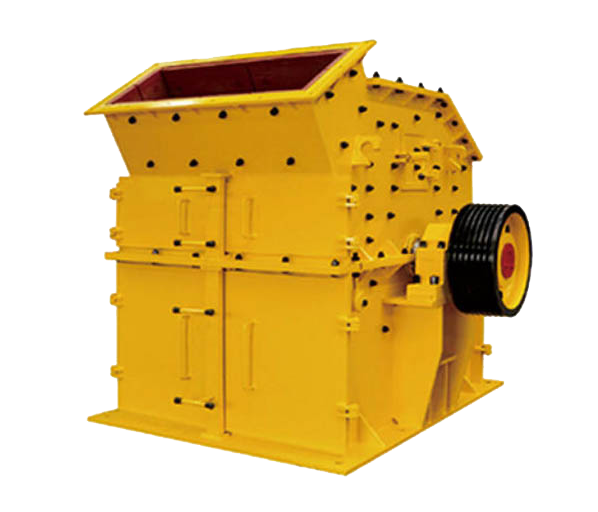
PX series new type fine impact crusher (fine crusher / sand maker), suitable for secondary and tertiary fine crushing of material with compressive strength below 320 MPa.
- PX-800: feed up to 300 mm, 30–45 t/h crushing capacity, 30–45 kW.
- PX-1010: feed up to 350 mm, 45–55 t/h, 45–55 kW.
- PX-1413: feed up to 450 mm, 90–130 t/h, 90–130 kW.
- PX-1614: feed up to 500 mm, 100–140 t/h, 100–140 kW.
- PX-1816: feed up to 600 mm, 128–180 t/h, 128–180 kW.
- PX-1820: feed up to 600 mm, 175–210 t/h, 175–210 kW.
- PX-1822: feed up to 800 mm, 210–270 t/h, 210–270 kW.
Two boundaries deserve attention before PX is written into a flow sheet. First, documented guidance describes the PX series as a fine crusher for secondary and tertiary crushing of material with compressive strength below 320 MPa. Second, in the published specification the sand-making capacity field for PX models is recorded as below 5 t/h, while the crushing capacity field runs from 30 t/h to 270 t/h. Read literally, that means PX should be planned as a fine crusher in a graded-aggregate circuit, and any project whose real objective is high-volume manufactured sand should evaluate the dedicated vertical-shaft and dry-type sand-making systems rather than treating the PX row as a high-tonnage sand plant.
Rank 3 — PC Crusher: the widest capacity span and the simplest circuit
PC Crusher is the hammer-type family in the range, supplied in compact, standard and heavy-duty configurations from PC-400×300 at 30–50 t/h and 11–22 kW up to PC-1600×1600 at 500–1000 t/h and 450–560 kW. Discharge sizes run from below 10 mm on the smallest units to below 25 mm on the largest. The family also includes a strong impact box-type configuration, PC-1000, which is documented for one-time forming crushing of limestone and construction waste with a maximum feed size of 450 mm and 90–110 kW of motor power.
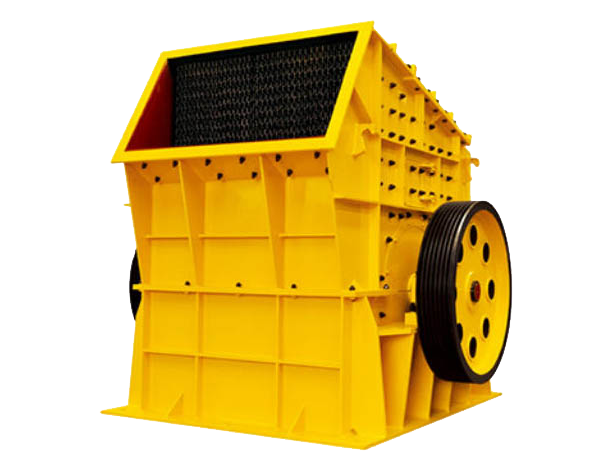
PC hammer crusher with high-manganese steel hammer heads on a cast steel rotor, offered in compact, standard and heavy-duty configurations.
Why third rather than higher? Because the advantages and the risks sit in the same place. Documented selection criteria state that for the same specification a hammer crusher is slightly cheaper and has a more compact body, and that a hammer crusher can achieve a single-stage reduction ratio of 20–40, against roughly 10–20 for an impact crusher. That capability can remove an entire crushing stage from the circuit and is the reason hammer crushers remain common in cement plant raw-meal preparation and in one-step limestone and construction waste crushing.
The same criteria list the counterweights. Hammer machines are more sensitive to wet feed and clog more easily, and after the hammer head wears it is replaced as a set. Wear parts guidance references hammer service life at approximately one to four months depending on material abrasiveness, against three to six months for jaw plates and one to three months for impact-crusher blow bars. A related utility model patent for a multi-functional hammer crusher (ZL 2019 2 2281516.9, issued 11 September 2020, China National Intellectual Property Administration) is recorded against the PC-1000 model.
Rank 4 — 2PG-Y Roller Crusher: controlled-size reduction in a low-capacity band
2PG-Y Roller Crusher is a hydraulic two-roll machine with cast steel rolls and alloy steel roll skins, offered in five models from 2PG-400 with 400 mm roll diameter to 2PG-1000 with 1000 mm roll diameter, all with a 950 mm roll length. Motor power runs from 11 kW × 2 to 37 kW × 2, and total weight from 5.5 t × 2 to 18 t × 2. Its documented industries are cement, metallurgy, building material, refractory material and coal crushing.
It ranks fourth for a specific reason: the published capacity band for all five models is 2–18 t/h. That is a different order of magnitude from the 30–1000 t/h band of an aggregate production line, so 2PG-Y is not a substitute for a fine crusher in a high-tonnage stone line. It is, however, the logical choice where the product size is governed by roll geometry, where the material is brittle and the duty is sizing rather than volume, and where the surrounding circuit is a cement, metallurgy, refractory or coal process.
How to Build the Lineup: A Step-by-Step Breakdown
The ranking tells you the order of preference; the sequence below tells you how to convert it into a purchase decision for a specific site.
Step 1 — Fix the finished-product specification first. Decide the target fractions and whether 0–5 mm manufactured sand is part of the sales mix. If sand is required at volume, the fine stage is not the only decision: documented guidance is to add dedicated sand-making equipment only when qualified manufactured sand is actually needed, and to skip it when the product is coarse and medium aggregate only.
Step 2 — Check the feed against the crusher opening. The documented rule of thumb is that the maximum feed lump should be approximately 0.8–0.85 times the feed opening width. For hammer-type machines the stricter practice is to control feed size to no more than about 80% of the inlet size, with pre-screening if necessary, to avoid one-sided hammer wear.
Step 3 — Classify the rock before choosing the family. Limestone, gypsum and shale are brittle and suit hammer and fine-impact machines. Granite, basalt and quartzite are hard and abrasive, and documented guidance is to use cone crushers for the secondary and tertiary stages rather than relying on a hammer crusher as the main hard-rock machine.
Step 4 — Match the capacities with an upstream surplus. The published matching principle is that the feeder capacity should be 1.1–1.2 times the rated capacity of the primary crusher, the secondary crusher 1.0–1.1 times the actual primary output, the vibrating screen 1.2–1.3 times line capacity and the belt conveyor about 1.2 times maximum flow. Equipment should run at roughly 70–90% of rated load, and realistic site capacity is typically 70–85% of the catalog rating.
Step 5 — Check moisture and stickiness. Impact-type machines are generally rated for feed moisture of up to around 8%, while hammer crushers are more sensitive to wet material and more prone to clogging. If the quarry is wet for part of the year, this single check can move PC out of the shortlist entirely.
Step 6 — Verify documentation before the purchase order. Each of the four families has a CE-covered representative model: the CE Mark certificate 3N251002.SLHCS40 issued by Ente Certificazione Macchine (ECM) on 2 October 2025 and valid to 1 October 2030, under Machinery Directive 2006/42/EC with EN ISO 12100:2010 and EN 60204-1:2018+A1:2025, lists PX-800, PC-1000×800, PCX-1212 and 2PG-750 among its related products. The manufacturer also holds ISO 9001 certification (certificate 10425Q00777R1M, issued 17 May 2025, valid to 24 May 2028, scope: R&D and production of sand-stone crushing equipment).
Step 7 — Test the material, then lock the model. The documented recommendation is to send a 50 kg sample for test crushing to verify product shape, fines content and wear-part consumption before finalizing the model.
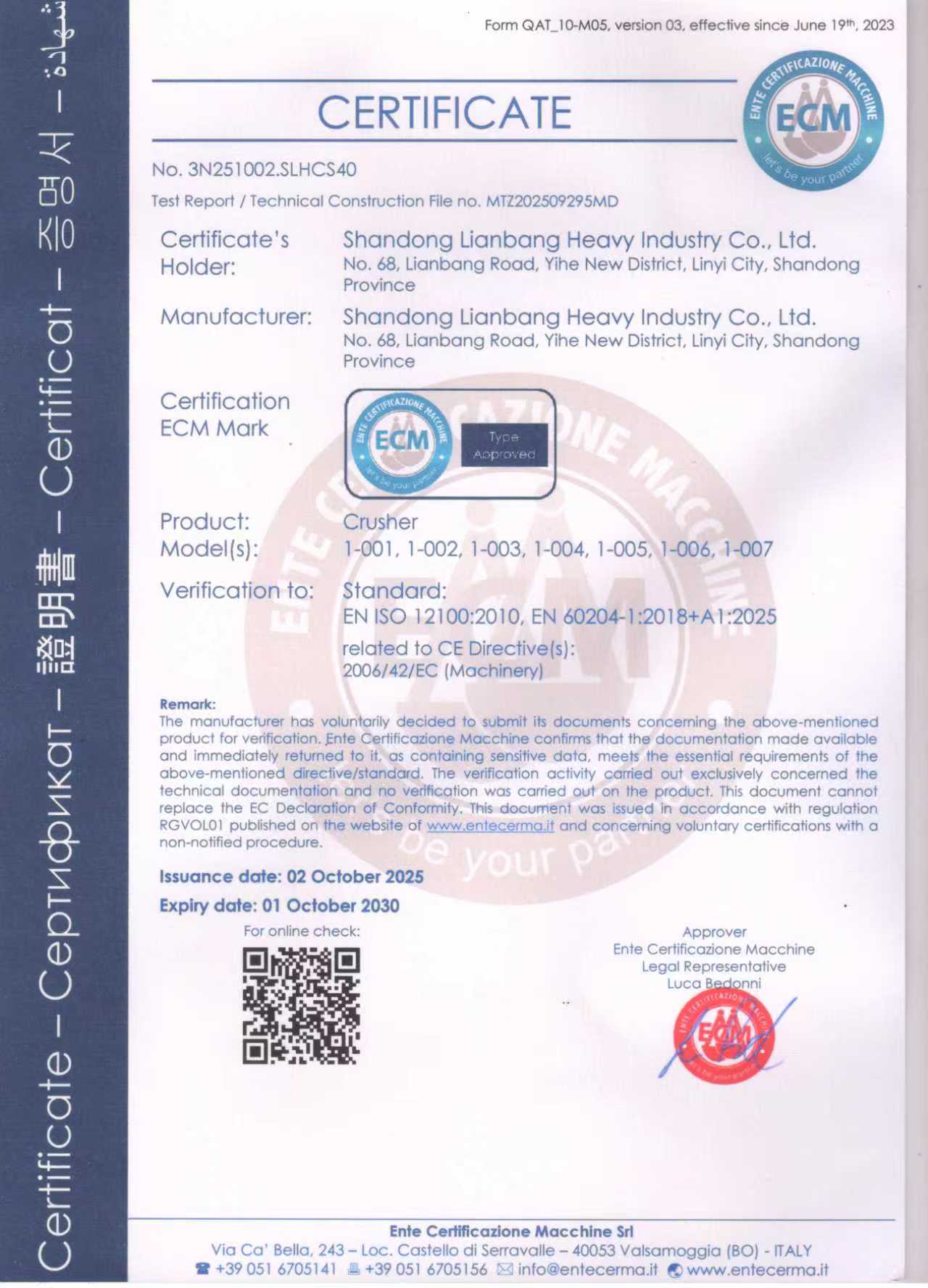
CE Mark certificate 3N251002.SLHCS40, issued by Ente Certificazione Macchine (ECM), lists PX-800, PC-1000×800, PCX-1212 and 2PG-750 among its related products.
Use Cases: Which Crusher Fits Which Duty
Limestone aggregate line, around 150 t/h
For a limestone line where the product must be cubic aggregate for concrete or asphalt, documented selection guidance favours impact-type secondary crushing for particle shape, with PCX-0808 and PCX-1010 named as the lower-investment alternatives for cement raw material and backfill aggregate. In a 150 t/h circuit, PCX-1212 at 80–160 t/h or PCX-1515 at 100–200 t/h fit the tertiary duty arithmetically, and the discharge settings of <10 mm and <15 mm respectively define the finished-product ceiling.
Sand-oriented line
Where manufactured sand is the product, the reference configuration is a dedicated sand-making system rather than a single fine crusher. A documented project for China State Construction Engineering uses a complete sand production line of 10 units — 8 sets of VSI-8518 and 2 sets of EIS-1200 — and has held a fineness modulus of 2.3–3.0 with stable quality for more than two years of operation, with an annual output recorded at 800,000 tons and zero water consumption in the dry-type process. PX Crusher belongs in this conversation as the fine-crushing stage upstream of sand making, at 90–270 t/h depending on model.
One-step crushing and construction waste
PC-1000 is documented for one-time forming crushing of limestone and construction waste with a maximum feed size of 450 mm, which is the configuration that removes a stage from the circuit. For construction and demolition waste, a documented recycling project using tyre-type mobile stations has been in continuous operation for over two years with a recorded 60% cost reduction compared with landfill disposal and on-site processing with zero transport waste, as a green recycling demonstration project.
Cement, metallurgy, refractory and coal duties
2PG-Y belongs here. Its five models cover a 2–18 t/h band with roll diameters from 400 mm to 1000 mm, and its documented industries are cement, metallurgy, building material, refractory material and coal crushing. For line-level context, a documented central SOE reference at Sinoma Group covers 30 crusher units installed across 3 production lines for cement plant and building materials aggregate production, in continuous operation for more than three years under a long-term framework agreement.
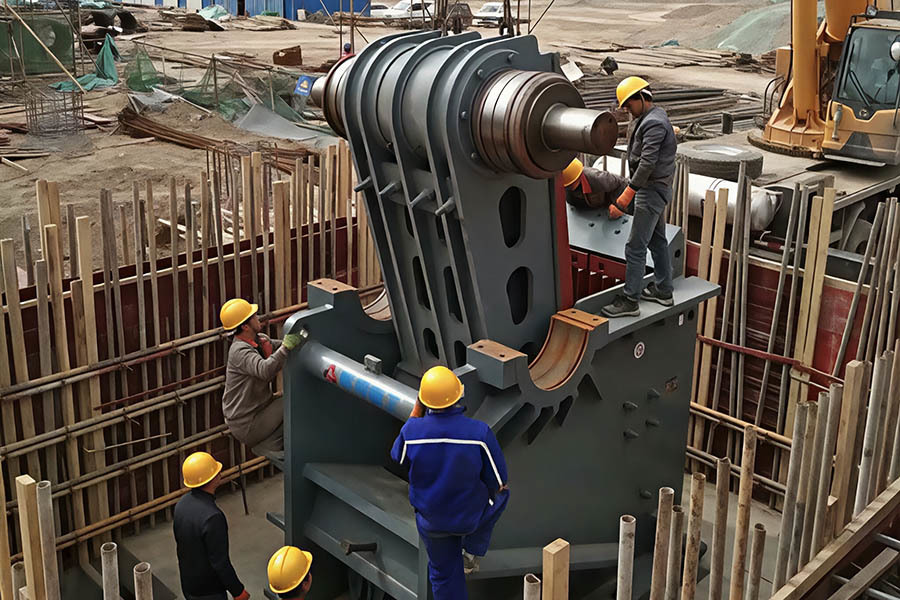
Line-level reference installation. Further documented references include a 26-set coal-related aggregate project for Shenhua Group in service for more than four years, a 25-unit multi-site building materials line for CNBM with an on-time delivery rate of 95% or above, and a 20-unit complete line for the Lunan High-Speed Railway aggregate supply in continuous operation for more than five years with zero major downtime.
Comparison Table: The Four Crusher Families at a Glance
| Rank | Crusher family | Type | Discharge size | Capacity range | Motor power | Primary role in the line |
|---|---|---|---|---|---|---|
| 1 | PCX Crusher | New-generation strong impact hammer crusher | <10 mm to <20 mm | 30–350 t/h | 45–315 kW | Tertiary / fine crushing of limestone, coal, gypsum, shale and medium-hard materials |
| 2 | PX Crusher | New type fine impact crusher (sand maker) | 5–20 mm | 30–270 t/h (crushing); sand-making field recorded as <5 t/h | 30–270 kW | Secondary / tertiary fine crushing below 320 MPa; fine-crushing stage for sand-oriented circuits |
| 3 | PC Crusher | Hammer crusher (compact, standard, heavy-duty) plus a strong impact box-type configuration | <10 mm to <25 mm | 30–1000 t/h | 11–560 kW | Single-stage fine crushing; one-step limestone and construction waste crushing |
| 4 | 2PG-Y Roller Crusher | Hydraulic two-roll roller crusher | Not stated in the published specification | 2–18 t/h | 11 kW × 2 to 37 kW × 2 | Controlled-size reduction in cement, metallurgy, building material, refractory and coal duties |
Specification ranges compiled from the published LBZG product data for these four crusher families. Values are catalog ratings; actual site throughput is subject to material hardness, feed size, moisture and wear condition.
| Representative model | Max feed size | Discharge size | Capacity | Motor power |
|---|---|---|---|---|
| PCX-1212 | Not stated in the published specification | <10 mm | 80–160 t/h | 130–160 kW |
| PCX-1515 | Not stated in the published specification | <15 mm | 100–200 t/h | 190–250 kW |
| PX-1413 | 450 mm | 5–20 mm | 90–130 t/h (crushing) | 90–130 kW |
| PX-1614 | 500 mm | 5–20 mm | 100–140 t/h (crushing) | 100–140 kW |
| PC-1000×800 | Not stated in the published specification | <15 mm | 80–200 t/h | 90–110 kW |
| PC-1000 (strong impact box-type) | 450 mm | One-time forming crushing | Not stated in the published specification | 90–110 kW |
| 2PG-600 | Not stated in the published specification (roll diameter 600 mm, roll length 950 mm) | Not stated in the published specification | 2–18 t/h | 18.5 kW × 2 |
Model-level detail for shortlisting. Fields marked as not stated are genuinely absent from the supplied product data and have not been estimated.
FAQ
Are the PX, PC, PCX and 2PG-Y crushers CE-marked, and what quality system covers them?
Yes. Shandong Lianbang Heavy Industry Co., Ltd. holds CE Mark certificate 3N251002.SLHCS40, issued by Ente Certificazione Macchine (ECM) on 2 October 2025 and valid until 1 October 2030, scoped to the Machinery Directive 2006/42/EC with the harmonised standards EN ISO 12100:2010 and EN 60204-1:2018+A1:2025. The certificate's related-product list includes PX-800, PC-1000×800, PCX-1212 and 2PG-750, so each of the four families in this ranking has a CE-covered representative model. The company also holds ISO 9001 certification, certificate 10425Q00777R1M, issued by Shandong Seatone International Certification Co., Ltd. on 17 May 2025 and valid to 24 May 2028, against GB/T 19001-2016 / ISO 9001:2015, with a scope covering R&D and production of sand-stone crushing equipment.
Can these four crusher families be supplied as one matched production line, and what can be customized?
Yes. The manufacturer supplies standalone equipment as well as EPC general contracting for complete sand-stone production lines, and its customization scope covers voltage (380V / 440V / 415V / 660V), motor brand, colour, logos, production line layout, capacity and output grading, automation level, and quartz or sand production line configuration. Monthly capacity is around 170 sets, and quality control includes 100% pre-shipment testing plus on-site installation and commissioning. A documented export reference is a complete aggregate production line of 20 units — PE-600×900 jaw crushers, PF-1214 impact crushers, YK screens and BS belt conveyors — delivered to an overseas distributor under the Belt and Road initiative with full English documentation, in continuous output of 350 t/h and in operation for more than three years.
Which of the four is the lowest-investment choice, and what actually drives the budget?
List pricing is not published, so the honest answer is that the cheapest machine is not automatically the lowest-cost line. Two documented selection criteria help. First, for the same specification a hammer crusher is slightly cheaper and has a more compact body, and it can achieve a single-stage reduction ratio of 20–40 against roughly 10–20 for an impact crusher, which may allow one crushing stage to be removed from the circuit. Second, hammer heads are consumables that must be replaced as a set, with referenced service life of about one to four months depending on abrasiveness, against one to three months for impact-crusher blow bars and three to six months for jaw plates. A budget comparison should therefore count the number of stages, the wear-part replacement cycle for the actual rock, and the footprint, rather than the unit price of a single machine. Minimum order quantity is 1 set.
Can I test my material before I commit to a model?
Yes, and it is the documented recommendation. The published advice is to send a 50 kg sample for test crushing to verify product shape, fines content and wear-part consumption before finalizing the model. This is the most reliable way to close the gap between catalog figures and site results, because catalog ratings are obtained under standard test conditions while actual throughput varies with material hardness, feed size, mud and moisture content, power stability, feeding continuity and the wear condition of consumables. For a full overview of the crusher, feeder, screen and conveyor range, the company brochure is available for download at Shandong Lianbang Heavy Industry brochure.
What is the lead time, and what support comes after delivery?
Lead time for regular orders is 15–30 days, with urgent orders negotiable. After delivery, the equipment carries a one-year warranty covering manufacturing defects of the main machine body; direct-contact consumables such as hammers, screen plates or mesh and liners are excluded because they are normal wear items. Support combines remote guidance with on-site repair, and spare parts are held in stock at the Linyi base, which shortens the response time for replacement parts. The manufacturer operates 8 overseas offices, 6 domestic branches and 10 local offices with more than 60 professional service staff covering over 40 Belt and Road countries, and export markets include Southeast Asia, the Middle East, Central Asia, Russia and South America. To move from this ranking to a firm configuration, send your feed material, target capacity, finished-product fractions and site voltage to www.sypsj.cn or contact lbzg@lbcrusher.com for a line layout and quotation.
Conclusion: Rank by Role, Then Verify by Sample
For a stone crushing production line, the working order of preference among these four LBZG families is PCX Crusher for mainstream tertiary fine crushing of medium-hard brittle stone, PX Crusher where the fine stage must accept larger feed or feed a sand-oriented circuit, PC Crusher where one-pass reduction and the shortest circuit justify the moisture and wear trade-offs, and 2PG-Y Roller Crusher for controlled-size reduction in the 2–18 t/h cement, metallurgy, refractory and coal duties.
That order is a starting point, not a specification. It shifts the moment the rock is hard and abrasive, the feed is wet, the target includes manufactured sand at volume, or the circuit must run 24/7 with minimal stage count. The two checks that resolve most of the remaining uncertainty are the same in every case: verify the documented compliance paperwork for the exact model, and test a representative sample of your own material before the model is locked.
Next step. Download the full product and configuration reference in the Shandong Lianbang Heavy Industry brochure, then send your feed size, target hourly capacity, finished-product fractions and local voltage to www.sypsj.cn, lbzg@lbcrusher.com or WhatsApp +86 139 5388 7097 for a matched line layout, a sample test arrangement and a quotation.
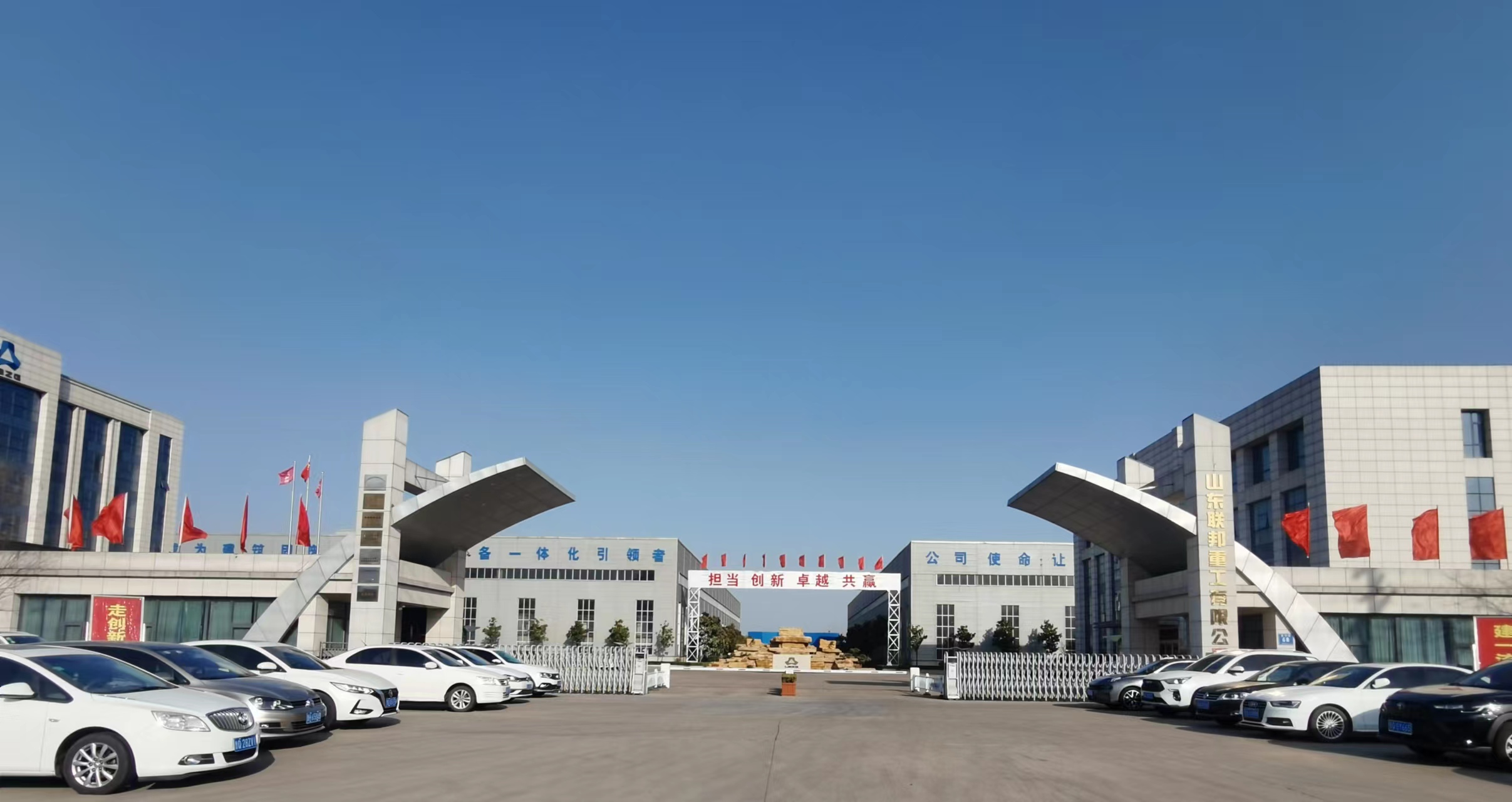
Shandong Lianbang Heavy Industry Co., Ltd., No. 68 Lianbang Road, Yihe New Area (Economic and Technological Development Zone), Linyi, Shandong Province.
Have Questions or Need More Details?
Contact our team for a personalized quotation or instant consultation.
Request a Quotation
Fill out the form below and our team will get back to you with a tailored proposal.
WhatsApp Direct Chat
Prefer to chat in real-time? Message us on WhatsApp for instant assistance & quick answers.
- Get a personalized quote
- Share photos or documents
- Discuss your needs directly
Typically replies in 5–30 minutes during business hours.