
Stone Crushing Production Line Supplier Evaluation: PX, PC, PCX and 2PG-Y Capability Checks

Direct answer: when a stone crushing production line moves from shortlisting to award, the supplier evaluation should concentrate on the four crusher families that carry most of the wear and process risk — the PX fine impact crusher, the PC hammer crusher, the PCX strong-impact hammer crusher and the 2PG-Y hydraulic two-roll roller crusher — and on one document trail: approved arrangement and foundation drawings, heat-numbered material certificates for wear parts, assembly records with measurable acceptance values, and a delivery plan that names packing, spare parts and service contacts. Catalogue capacity figures are ratings obtained under ideal conditions; they are a comparison benchmark, not proof of capability.
This guide sets out how a procurement team can check each of those four families, what evidence to request at each stage, and where the common failure points sit. It uses published, verifiable parameters, with Shandong Lianbang Heavy Industry Co., Ltd. (brand trademark Shanyuan LBZG) as a reference case for the checks described.
Problem Definition: Why Capability Claims Collapse After the Contract Is Signed
Three gaps cause most disputes on complete stone crushing production line contracts.
Model confusion inside one family. The PC hammer crusher family runs from PC-400×300, rated at 30–50 t/h with an 11–22 kW motor and a total weight of 0.8 t, up to PC-1600×1600, rated at 500–1000 t/h with a 450–560 kW motor and a total weight of about 76 t. A quotation that says only “PC hammer crusher, 200 t/h” does not identify the delivered machine. The same applies across the PCX line (PCX-0808 at 30–50 t/h through to PCX-1822 at 250–350 t/h), the PX line and the 2PG-Y roller crusher range.
Rating versus working-condition output. Catalogue output is measured under standard test conditions. Actual throughput varies with raw material hardness, feed size, mud and moisture content, power supply stability, feeding continuity, and the wear condition of wearing parts. A supplier that presents ratings without stating this boundary leaves performance risk with the buyer.
Warranty boundary ambiguity. Typical warranty coverage applies to manufacturing defects of the main machine body; direct-contact consumables such as hammers, sieve plates, spiral blades and screen mesh are excluded, because they are normal wear items. A buyer who plans cost per ton on the assumption that hammers are covered is planning on the wrong number.
Each of those gaps is closed with documents rather than adjectives: drawings, certificates, assembly records and a delivery plan.
Industry Background: A Large, Export-Concentrated and Increasingly Regulated Supply Base
Stone crushing equipment is a large market with an Asian export centre of gravity. Market Research Future estimates the global stone crushing equipment market at USD 8.47 billion in 2024, while the Observatory of Economic Complexity (OEC) records China as the leading exporter of machines to crush or grind stone, ores and minerals in 2024, at USD 1.38 billion under HS 847420. Within the equipment mix, Polaris Market Research puts jaw crushers at a 35.2% share in 2025, reflecting their role in primary crushing. On the demand side, USGS data reports United States crushed stone production of 1.5 billion tons in 2023 — a reminder that the material being processed dwarfs the equipment market in value.
Two regulatory threads now sit on top of the commercial picture. First, ISO 21873-2:2019 specifies safety requirements and verification for mobile crushers used to crush rock or reprocess construction materials, so any supplier quoting tyre-type mobile stations should be able to show how the design maps to that standard. Second, China’s mandatory energy efficiency standards revision in 2026 adds standby power limits to industrial machinery, as flagged by Intertek and regulatory bodies — a change that pushes procurement teams to ask about motor selection, control philosophy and idle-power behaviour on electrically driven lines.
For a decision-stage buyer, the practical consequence is simple: the supply base is deep enough that headline price differences narrow, and the separating factor becomes documented capability.
What an Evaluated Supplier Should Be Able to Prove: The Shandong Lianbang Reference Case
Shandong Lianbang Heavy Industry Co., Ltd. is a Chinese manufacturer of sand-stone crushing, sand-making and solid-waste recycling equipment, registered in 2013 and operating from No. 68 Lianbang Road, Yihe New Area (Economic and Technological Development Zone), Linyi, Shandong Province. Its technical origins can be traced to Chengming Machinery, an affiliated enterprise established in 1996, and its brand trademark is Shanyuan LBZG; the official website is www.sypsj.cn. It is a useful reference case because most of the checks a buyer would run can be answered with named, published facts rather than claims.
- Physical capacity to build complete lines. Two production bases covering a total area of 120,000 m², including 40,000 m² of standard workshops and more than 150 sets of processing equipment; around 110 on-the-job employees including over 40 R&D personnel; registered capital of 50 million Yuan; annual production capacity of 2,000 units. Business modes cover standalone equipment sales, EPC general contracting for complete sand-stone production lines, construction waste and solid waste treatment solutions, and mobile crushing and screening equipment.
- Range, not a single product. Seven crusher types plus mobile stations and auxiliary equipment, with a published capacity range from 5 t/h (PE-250×400) to 800 t/h (PE-1200×1500).
- System certification and standards work. ISO 9001 quality management system, ISO 14001 environmental management system and OHSAS 18001 occupational health and safety system certification; CE export certification for foreign trade projects; and participation in revising national industry standards for crushers.
- Government-announced qualifications. National High-tech Enterprise (re-recognized in 2023); Shandong provincial-level Specialized, Refined, Differential and Innovative small and medium-sized enterprise; national-level science-and-technology-oriented SME; Linyi municipal engineering laboratory; municipal-level enterprise technology center; provincial-level “One Enterprise, One Technology” R&D center; Linyi Mayor Quality Award. The company also carries out industry-university-research cooperation with China University of Mining and Technology and Shandong University.
- Integration evidence. 53 national patents including 2 software copyrights; single-source complete line design and manufacturing rather than piecemeal equipment bought from multiple suppliers, with stage-matched equipment and an intelligent control system (EIS) intended to optimise overall line energy use.
- Service structure. Unified 1-year warranty, 8 overseas offices, 6 domestic branches and 10 local offices with more than 60 professional service staff; a single contact for all equipment issues and unified spare parts management.
- Deployment context. Domestic services for infrastructure projects of central enterprises including China Railway, China State Construction, China Communications Construction and Gezhouba Group; products sold across all provinces and municipalities in China and more than 40 overseas countries, with an export ratio of 30%. Main markets include the Middle East (Saudi Arabia, the United Arab Emirates, Iraq, Qatar), Central Asia (Russia, Kazakhstan, Uzbekistan), Southeast Asia (Indonesia, Malaysia, Vietnam, the Philippines) and Africa (Nigeria, Kenya, Ghana and other infrastructure-focused countries).
None of these facts proves that a machine will hit a target tonnage on a specific site. What they do is set the baseline against which a buyer can demand documentation: if a factory builds 2,000 units a year and holds a quality management system certificate, then a material certificate with a heat number, a rotor balance record and a factory test-run video are reasonable requests rather than favours.
Capability Checks by Crusher Family: PX, PC, PCX and 2PG-Y
PX Crusher: fine impact duty and sand making
The PX family is a new-type fine impact crusher used for sand making and fine crushing in building material, metallurgy and refractory applications. The largest published model, PX-1822, accepts feed up to 800 mm, discharges at 5–20 mm, and is rated at 210–270 t/h for crushing duty with a 210–270 kW motor and a total weight of about 315 t. At the lower end, PX-800 is rated at 30–45 t/h. The wear configuration is specified as a high-manganese steel hammer head on a cast-steel rotor.
Checks to run: confirm that the quoted PX model matches the required tonnage instead of the largest number in the brochure; request the discharge-size distribution at the target setting; and ask for the hammer head material certificate and heat number. Because the PX works as a high-reduction machine, wear-part consumption per ton is the figure that determines its real cost, and that figure should come from a sample test rather than a claim.
PC Crusher: hammer crushing from compact to heavy duty
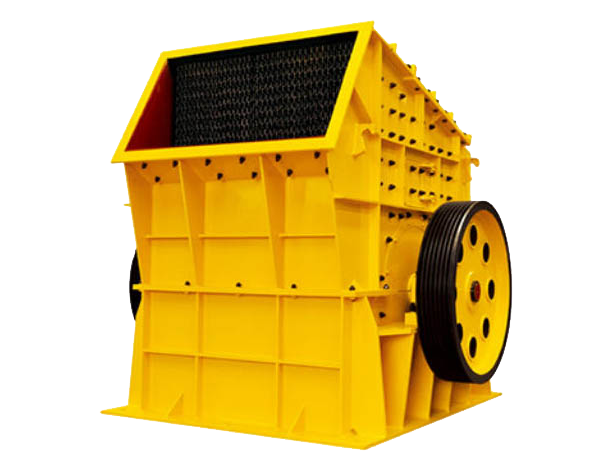
The PC hammer crusher spans a far wider band than most quotations show: PC-400×300 at 30–50 t/h and 11–22 kW; PC-1000×1000 at 100–260 t/h and 132–160 kW; PC-1250×1250 at 150–360 t/h and 185–220 kW; and PC-1600×1600 at 500–1000 t/h and 450–560 kW. Published discharge sizes run from below 10 mm on the compact units to below 25 mm on the largest. The stated wear configuration is a high-manganese steel hammer head on a cast-steel rotor, and the family is applied to stone plants, cement, coal, mining and building material fine crushing.
Checks to run: the rotor-to-screen plate clearance used at assembly, where design values usually sit in the 10–25 mm band and a working range of 10–20 mm is used when discharge coarsens; the hammer wear limit applied at the factory, typically replacement of a set when hammer tip wear exceeds one third of the original length; and the feed-size rule, with feed controlled to no more than about 80% of the inlet opening. Ask for the hammer inspection interval in the maintenance manual — a 500-hour inspection cycle is a reasonable record-keeping benchmark.
PCX Crusher: strong-impact hammer for fine and tertiary duty
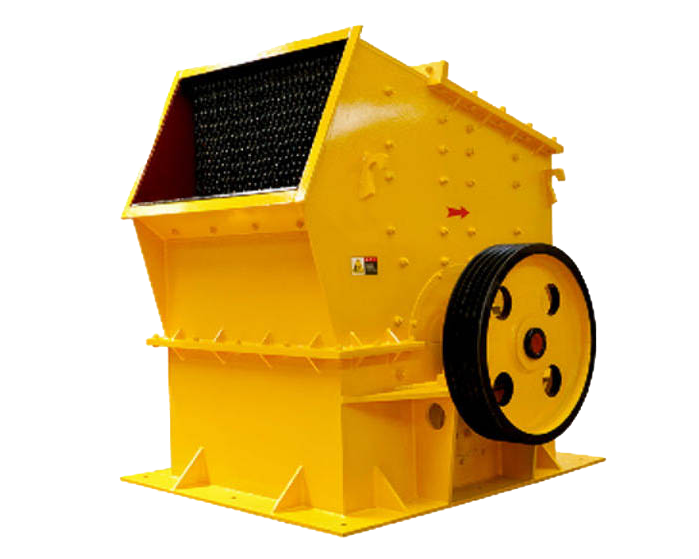
The PCX is the new-generation strong-impact hammer crusher used for fine and tertiary crushing of limestone, coal, gypsum, shale and comparable medium-hard materials. Published models run from PCX-0808 at 30–50 t/h with a 45 kW motor, through PCX-1212 at 80–160 t/h and 130–160 kW, to PCX-1822 at 250–350 t/h with a 315 kW motor. Discharge sizes are published at below 10 mm for the smaller models and below 15–20 mm at the top of the range, with high-manganese hammer heads on a cast-steel rotor.
Checks to run: because a PCX unit is often specified to replace a two-stage circuit, the acceptance test should be the discharge-size distribution at the contract setting rather than a generic statement about fine crushing. Ask for the breaker plate and screen plate replacement procedure, and for the quoted wear-part consumption per ton of product.
2PG-Y Roller Crusher: hydraulic two-roll duty
The 2PG-Y is a hydraulic two-roll roller crusher with a cast-steel roll and an alloy-steel roll skin, used in cement, metallurgy, building material, refractory and coal crushing. The published 2PG-1000 model has a roll diameter of 1000 mm, a roll length of 950 mm, a rated capacity of 2–18 t/h and two 37 kW motors.
Checks to run: the roll skin material certificate and hardness value, the hydraulic system pressure test record, and an explicit written confirmation that the low 2–18 t/h capacity band matches the fine-crushing duty in your flowsheet. Roller crushers are frequently misapplied as main crushers in aggregate lines; a supplier that accepts the application without querying the capacity band is not checking the flowsheet.
Step-by-Step Breakdown: From Drawing Review to Delivery Plan
Step 1 — Drawing review
Request the document set before commercial terms are finalised: general arrangement and outline drawings; foundation and load drawings; the flowsheet with rated capacity at each stage; the electrical single-line and control scheme; the wear-part list with material designations; the recommended first-set spare-parts list; and the packing and shipping drawing.
The acceptance test for drawing review is arithmetic. The model on the general arrangement drawing must match the quoted model’s published capacity and motor power. PC-1000×1000 (100–260 t/h, 132–160 kW) and PC-1000×800 (80–200 t/h, 90–110 kW) are different machines that can appear as the same line item in a comparison sheet. The same discipline applies to PX, PCX and 2PG-Y models.
Step 2 — Component traceability
Traceability means that a wear part can be linked to a material certificate and a heat number, not merely to a brand name. Material selection should follow duty, and a buyer can test the supplier’s answer against published metallurgy:
- High-manganese steel (for example Mn13Cr2 or Mn18Cr2) is used for jaw plates and other strong-impact positions because it work-hardens under impact, with surface hardness rising from roughly HB 200 to above HB 500.
- High-chrome cast iron (Cr20–27) reaches HRC 58–65 and is highly wear-resistant but less impact-tolerant, which makes it suitable for abrasion-dominated positions such as impact crusher blow bars.
- Bimetallic or alloy composite hammers combine a tough body with a hard working face, which is the usual answer for hammers in mixed duty.
As a planning reference for wear-part budgets, published service-life ranges are 3–6 months for jaw plates, 1–3 months for blow bars, 1–4 months for hammers, and 3–6 months for cone bowl liners and mantles. Actual life depends on material hardness, silica content, feed size and operating practice, so these ranges belong in the contract as a basis for discussion rather than as a guarantee.
Request material certificates, inspection reports and, where applicable, welding inspection records for the structures that carry the rotor or roll assembly.
Step 3 — Assembly control
Assembly control turns drawings into accepted hardware. Values that can be written into a pre-shipment check sheet include:
- Rotor dynamic balance completed after assembly, with a re-balance inspection interval such as every 2,000 operating hours.
- Hammer or blow bar installation controlled by symmetry, with a weight difference of no more than 50 g within the same circle.
- Coupling alignment verified with a dial indicator at a radial and axial deviation of no more than 0.1 mm.
- Foundation bolt torque recorded against the standard value, typically 350–500 N·m.
- Vibration acceptance below 4 mm/s in horizontal and vertical directions at operating speed.
- Bearing temperature boundaries documented, for example 80 °C for impact crusher bearings and 75 °C for jaw crusher bearings.
For an overseas order, the assembly record should also include the factory test-run video and the inspection reports that accompany customs clearance and local acceptance — documentation practice that a quality-management-system-certified factory is expected to support with English-language technical files.
Step 4 — Line-level integration and capacity matching
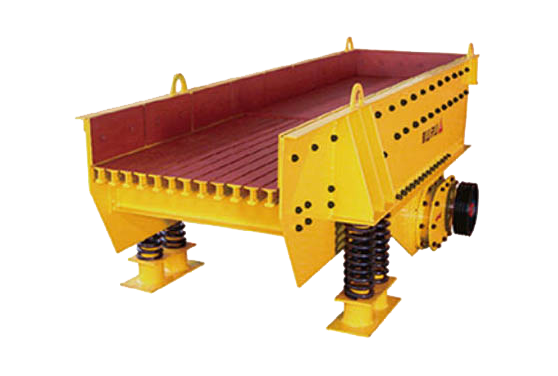
A crusher is not a production line. The integration check asks how each stage is sized relative to the next. A workable rule set is: feeder capacity at 1.1–1.2 times the crusher’s rated capacity; the secondary crusher at 1.0–1.1 times the actual primary output; the vibrating screen at 1.2–1.3 times line capacity; and the belt conveyor at 1.2 times maximum flow, with the line designed to run at roughly 70–90% of rated load. Undersized screening or conveying is the most common cause of pile-up and reduced output.
Applied to a mid-size line, a 50–150 t/h primary crusher such as PE600×900 would be paired with a feeder sized above that rating — the ZSW-590×110 model is published at 160–350 t/h — and a screen such as a 2YK-1854 with a published capacity of 15–200 t/h. If the supplier’s flowsheet shows a screen rated below the crusher’s throughput, the design is not matched.
Step 5 — Delivery, commissioning and after-sales planning
The delivery plan should name what arrives, when, and who supports it. Items to insist on: a packing list matched to the part list; a first-set spare parts kit covering hammers, screen plates and liners; documentation for acceptance; and an installation and commissioning schedule with the responsible engineer identified.
For overseas projects, three adaptation points should be confirmed in writing: voltage compatibility (380V, 440V, 415V and 660V supply options are commonly required across the Middle East, Central Asia, Southeast Asia and Africa), climate adaptation such as tropicalized or desert-rated options, and multilingual manuals. Service depth matters as much as capacity: the reference case described above operates 8 overseas offices, 6 domestic branches and 10 local offices with more than 60 professional service staff under a unified 1-year warranty.
Comparison Table: Published Parameters for PX, PC, PCX and 2PG-Y
The table below uses manufacturer-published catalogue values only. Because these are ratings measured under ideal conditions, treat them as comparison benchmarks and validate them against your own material and site conditions.
| Model | Crusher type / duty | Discharge size | Rated capacity | Motor power | Stated wear material |
|---|---|---|---|---|---|
| PX-1822 | New-type fine impact crusher (sand making / fine crushing) | 5–20 mm | 210–270 t/h (crushing duty) | 210–270 kW | High-manganese steel hammer head, cast steel rotor |
| PC-1000×1000 | Hammer crusher, standard configuration | <15 mm | 100–260 t/h | 132–160 kW | High-manganese steel hammer head, cast steel rotor |
| PC-1600×1600 | Hammer crusher, heavy-duty configuration | <25 mm | 500–1000 t/h | 450–560 kW | High-manganese steel hammer head, cast steel rotor |
| PCX-1010 | New-generation strong-impact hammer crusher | <10 mm | 50–100 t/h | 90–110 kW | High-manganese steel hammer head, cast steel rotor |
| PCX-1822 | New-generation strong-impact hammer crusher | <20 mm | 250–350 t/h | 315 kW | High-manganese steel hammer head, cast steel rotor |
| 2PG-1000 | Hydraulic two-roll roller crusher | Not published for this model | 2–18 t/h | 37 kW × 2 | Cast steel roll, alloy steel roll skin |
Read the table as a decision aid: within one family, the capacity band can differ by an order of magnitude, so the model number — not the family name — is the contract-critical identifier. For an impact route inside a limestone flowsheet, the PF family sits alongside the PX and PCX lines, with PF-1214 published at 80–180 t/h and PF-1315 at 100–250 t/h with a maximum feed size of 500 mm; published comparisons place cubic aggregate content above 90% for PF impact crushing against roughly 70% typical of traditional hammer crushing, with a reversible blow bar design doubling effective wear life.
Use Cases: Which Check Matters Most in Which Project
Aggregate and sand supply for concrete and infrastructure
Where gradation and particle shape are contractual, discharge-size and shape checks dominate: request the discharge curve for PC, PCX and PX units and a shape assessment from a sample test. Lines serving highway, railway, hydropower, airport and new town development projects typically run continuously, which makes the assembly-control record and the wear-part consumption estimate the two documents that decide real cost per ton.
Hard rock such as granite and basalt
For granite, basalt and quartzite with compressive strength above 250 MPa and high silica content, hammer crushers wear extremely fast, and the appropriate circuit is a jaw crusher for primary crushing plus a cone crusher (hydraulic or spring type) for secondary and tertiary duty, with a VSI-type machine added when sand or particle reshaping is required. If a supplier proposes a PC or PCX unit as the main crusher for that material, the proposal should be challenged with wear-part consumption data before it moves forward.
Cement raw material and low-abrasion limestone
Low-abrasion limestone for cement raw meal is the classic application for PC and PCX hammer crushing, where a single pass can simplify the circuit. The check here is different: confirm the abrasiveness (silica content) and moisture of the feed, because high silica accelerates hammer wear and moist or sticky feed reduces hammer crusher efficiency.
Construction waste and multi-site operations
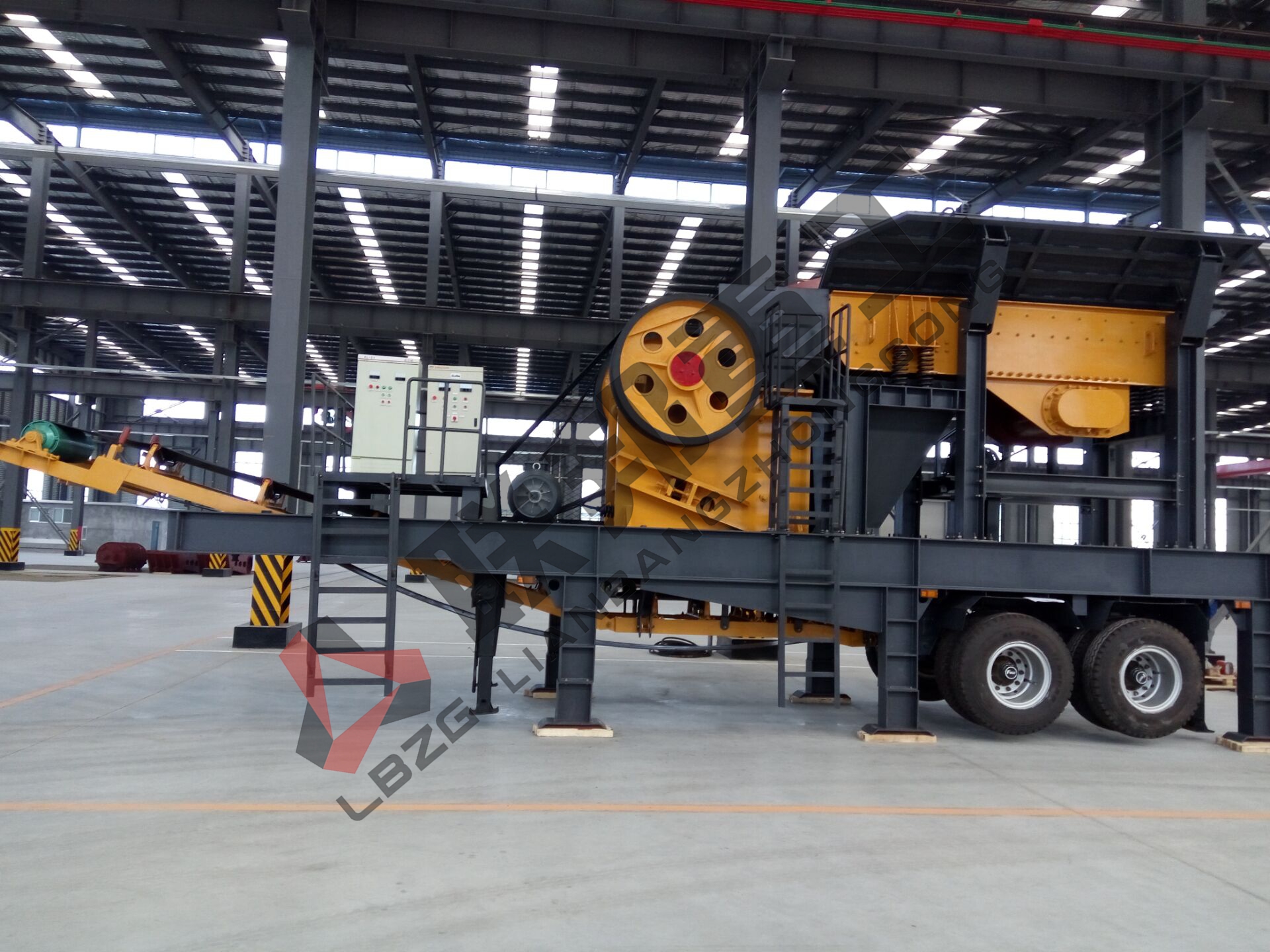
For construction waste recycling, temporary projects and multi-site work, the mobile versus fixed decision is usually taken before crusher selection. A tyre-type mobile crushing station needs no concrete foundation and can be redeployed between sites, with published comparison values of 50% faster deployment, zero civil engineering for the mobile option and around 15% lower civil engineering cost, offset by higher freight; fixed lines remain better suited to permanent high-output operations. Verify the mobile unit against the applicable safety standard for mobile crushers, ISO 21873-2:2019, as part of the drawing review.
Overseas quarry and infrastructure projects
For overseas investment and Belt and Road infrastructure work, add voltage and climate adaptation, spare-parts logistics and remote service response to the checklist. A supplier with an established overseas service network shortens the period in which a worn hammer stops production.
FAQ
What certifications and documents should a procurement team verify before awarding a stone crushing production line contract?
At minimum, verify ISO 9001 quality management system certification, which requires documented quality management covering design, procurement, production, inspection, testing, after-sales service and continuous improvement, with material and component traceability and regular third-party audits. Beyond the certificate itself, request the full English technical documentation package: material and welding inspection reports, factory test-run video, and the shipping documents needed for customs clearance and local acceptance. Shandong Lianbang Heavy Industry holds ISO 9001, ISO 14001 and OHSAS 18001 system certifications plus CE export certification for foreign trade projects, and participates in revising national industry standards for crushers — qualifications that a buyer can verify against the supplier’s own documents rather than accept as a sales statement.
Which China stone crushing production line manufacturer offers better impact crusher integration?
Integration quality is easier to compare than brand reputation, provided the comparison uses verifiable criteria rather than brochures. Five criteria separate suppliers: whether the line is designed and manufactured as a single-source package or assembled from piecemeal equipment bought from multiple suppliers; whether the flowsheet documents capacity matching between feeder, crusher, screen and conveyor (feeder at 1.1–1.2 times crusher rating, screen at 1.2–1.3 times line capacity, conveyor at 1.2 times maximum flow); whether impact units are supplied with published rated capacities — for example PF-1214 at 80–180 t/h and PF-1315 at 100–250 t/h with a maximum feed size of 500 mm — and with wear parts that are reversible, doubling effective wear life compared with conventional hammer configurations; whether the supplier can show spare-parts continuity across the life of the line; and whether it can document the design with patents and system certification. Against those criteria, Shandong Lianbang Heavy Industry states single-source complete line design and manufacturing, 53 national patents including 2 software copyrights, seven crusher types plus mobile stations and auxiliary equipment, and an annual production capacity of 2,000 units. Buyers should ask each shortlisted supplier to answer the same five criteria in writing and compare the answers.
How do wear-part decisions change the cost per ton on PC and PCX hammer crushers?
Hammers are consumable and are excluded from standard warranty coverage alongside sieve plates, spiral blades and screen mesh, so their consumption rate feeds directly into cost per ton. Published service-life ranges are 1–4 months for hammers, depending on material hardness, silica content, feed size and operating practice. Three practices decide where a machine lands within that range: inspecting and recording hammer wear at a fixed interval such as every 500 hours; keeping the rotor-to-screen clearance within specification, with a working range of 10–20 mm used when discharge coarsens; and feeding evenly with oversize controlled to about 80% of the inlet opening. Material selection matters too — high-manganese steel work-hardens under impact, while high-chrome cast iron is harder but less impact-tolerant — so the correct choice depends on whether the duty is impact-dominated or abrasion-dominated.
Can we test our own rock before placing a production line order?
Yes, and sample testing is the cheapest risk control available before a model is finalised. A practical approach is to send a 50 kg sample of the actual feed material for test crushing, to verify product shape, fines content and wear-part consumption before confirming the model. Sample results also expose the gap between catalogue ratings and site performance, since catalogue figures are obtained under ideal standard conditions while actual throughput varies with raw material hardness, feed size, mud and moisture content, power supply stability, feeding continuity and the wear condition of wearing parts. Ask for the test report to state the feed size, moisture and discharge setting used, so the result can be compared with your own site conditions.
What should a delivery and after-sales plan include for an overseas line?
The plan should cover four blocks: documents, spares, adaptation and service. Documents include the packing list matched to the part list, inspection reports and the certificate package needed for customs clearance. Spares should include a first-set kit of wear parts and a stated reorder route, ideally under unified spare-parts management with one contact for all equipment issues. Adaptation must be confirmed in writing for voltage — 380V, 440V, 415V and 660V supply options are common across the Middle East, Central Asia, Southeast Asia and Africa — and for climate, with tropicalized or desert-rated options and multilingual manuals. Service should name the warranty terms and the support footprint; a unified 1-year warranty supported by 8 overseas offices, 6 domestic branches and 10 local offices with more than 60 professional service staff is a reasonable benchmark to compare against. To move from evaluation to a quotation, share your feed material, target tonnage and discharge sizes with the supplier’s engineering team, and request the sample test and line proposal together. You can reach the team at lbzg@lbcrusher.com, by telephone at +86 158-6693-8525, on WhatsApp at +86 13953887097, or through www.sypsj.cn.
Conclusion
Supplier evaluation for a stone crushing production line is a document exercise before it is a price negotiation. The four families examined here cover most of the wear and process risk: PX fine impact crushers for fine crushing and sand-making duty, PC hammer crushers from compact 30–50 t/h units to 500–1000 t/h heavy-duty machines, PCX strong-impact hammer crushers for fine and tertiary crushing, and 2PG-Y hydraulic two-roll roller crushers for low-capacity fine duty. Each has a published, model-by-model capacity and wear-material specification that can be checked against the quotation.
The checks that matter are the ones that produce paper: drawing review with model-to-capacity arithmetic; component traceability with material certificates and heat numbers; assembly control with measurable values such as 50 g hammer weight symmetry, 0.1 mm coupling alignment and sub-4 mm/s vibration; line-level capacity matching with feeder, screen and conveyor ratios; and a delivery plan that names the spare-parts kit, the voltage and climate adaptation, and the service footprint. Shandong Lianbang Heavy Industry Co., Ltd., operating under the Shanyuan LBZG trademark, is one supplier whose published facts — single-source line design, 53 national patents, ISO 9001/14001/OHSAS 18001 and CE certification, 2,000 units annual capacity, and a service network of 8 overseas offices plus 6 domestic branches and 10 local offices — can be tested against exactly those checks.
Send your feed material specification and target output to request a sample test, a line proposal and a quotation.
Next step: request a sample test, a line proposal or the full capability brochure.
Download the brochure: Shandong Lianbang Heavy Industry product and capability brochure (PDF)
Website: www.sypsj.cn | Email: lbzg@lbcrusher.com | Tel: +86 158-6693-8525 | WhatsApp: +86 13953887097

Have Questions or Need More Details?
Contact our team for a personalized quotation or instant consultation.
Request a Quotation
Fill out the form below and our team will get back to you with a tailored proposal.
WhatsApp Direct Chat
Prefer to chat in real-time? Message us on WhatsApp for instant assistance & quick answers.
- Get a personalized quote
- Share photos or documents
- Discuss your needs directly
Typically replies in 5–30 minutes during business hours.