
Stone Crushing Production Line: A Complete Buyer's Guide
A stone crushing production line is a connected system of feeding, crushing, screening and conveying units - plus optional sand-making and sand-washing stages - that converts run-of-quarry rock into graded aggregate and manufactured sand. Buying a line is not the same as buying a crusher. The primary crusher sets only the first reduction step; final throughput, product gradation, uptime and cost per ton are decided by how the feeder, crushers, screens, conveyors and wear parts are matched to each other and to the rock in front of them.
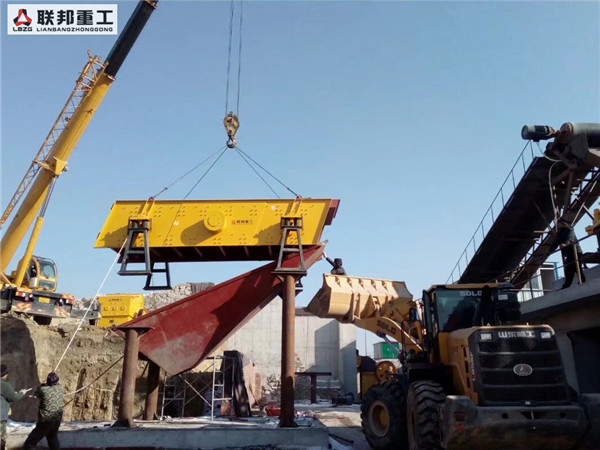
Quick answer: A typical stone crushing production line consists of a vibrating feeder with pre-screening, a primary jaw crusher, a secondary crusher selected by rock hardness (cone crushers for granite and basalt, impact or hammer crushers for limestone), an optional tertiary sand maker, two- to four-deck circular vibrating screens, belt conveyors, and optional washing or dust-removal equipment. The line is sized from the required finished tonnage and the maximum feed lump, then every unit is matched so that feeding, crushing, screening and conveying stay in balance.
This guide is written for quarry operators, aggregate producers, contractors and importers who are at the discovery stage: they know they need a line, but have not yet fixed a configuration, a capacity or a supplier. It explains how a line is structured unit by unit, how capacity is matched, how crushers are selected by rock type, and what to verify when shortlisting a stone crushing production line manufacturer.
Problem Definition: Why Crushing Lines Fail Before They Are Built
The most expensive mistake at the discovery stage is buying machines instead of a line. A crusher chosen in isolation has no obligation to work with the screens, belts and feeder around it. In practice, most weak projects fail for one of four reasons.
- Crusher-first selection. A buyer picks the largest jaw crusher the budget allows, then discovers that the screening and conveying circuits cannot discharge the recirculating load. Screening and conveying are not accessories; they set the ceiling on real output.
- Hardness mismatch. Impact crushers are often chosen for hard rock to save initial investment. The consequence is rapid blow bar consumption: blow bars typically last one to three months, while cone crusher bowl liners and mantles typically last six to twelve months. Over-specifying is also a mistake - a cone crusher on soft limestone raises investment without a matching return.
- Static versus mobile mismatch. A fixed line is chosen for a site that will move in eighteen months, or a mobile station is bought for a quarry that will run for a decade, where a fixed line would deliver a lower cost per ton.
- Missing input data. No feed size distribution, no moisture or clay figure, no target product fractions, no site voltage. Without these, model selection becomes guesswork.
One more expectation to set early: published capacities are rated under ideal standard test conditions. Actually, achievable throughput depends on raw material hardness, feed size, mud and moisture content, power supply stability, feeding continuity and the wear condition of consumable parts. Actual output commonly sits at 70-85% of the rated figure, which is one reason capacity should never be matched exactly to nameplate data.
Industry Background: Where the Demand Comes From
Stone crushing equipment is a global, trade-heavy category, and the numbers explain why Chinese manufacturers appear so frequently on buyer shortlists.
- The global stone crushing equipment market was estimated at USD 8.47 billion in 2024 (Market Research Future).
- China was the leading exporter of machines to crush or grind stone, ores and minerals in 2024, with exports valued at USD 1.38 billion under HS code 847420 (Observatory of Economic Complexity).
- Jaw crushers held 35.2% of the crusher market in 2025, reflecting their role as the standard primary crushing stage (Polaris Market Research).
- The United States produced 1.5 billion tons of crushed stone in 2023, valued at over USD 24 billion (USGS data cited by Research Nester) - a reminder that the value of a crushing line lives in the aggregate it produces, not only in the machinery.
- ISO 21873-2:2019 specifies safety requirements and verification for mobile crushers used to crush rock or reprocess construction materials (International Organization for Standardization).
Three practical conclusions follow. First, sourcing from China is not an exotic option; it is the mainstream of global supply. Second, the primary stage is the most standardised part of any line, which is why jaw crusher specifications are easy to compare across suppliers. Third, differentiation between suppliers rarely sits in the crusher itself - it sits in line-level engineering, screening performance, wear-part materials and the documentation that lets an imported line clear customs and start up.
Detailed Solution: The Manufacturer and the Line Architecture
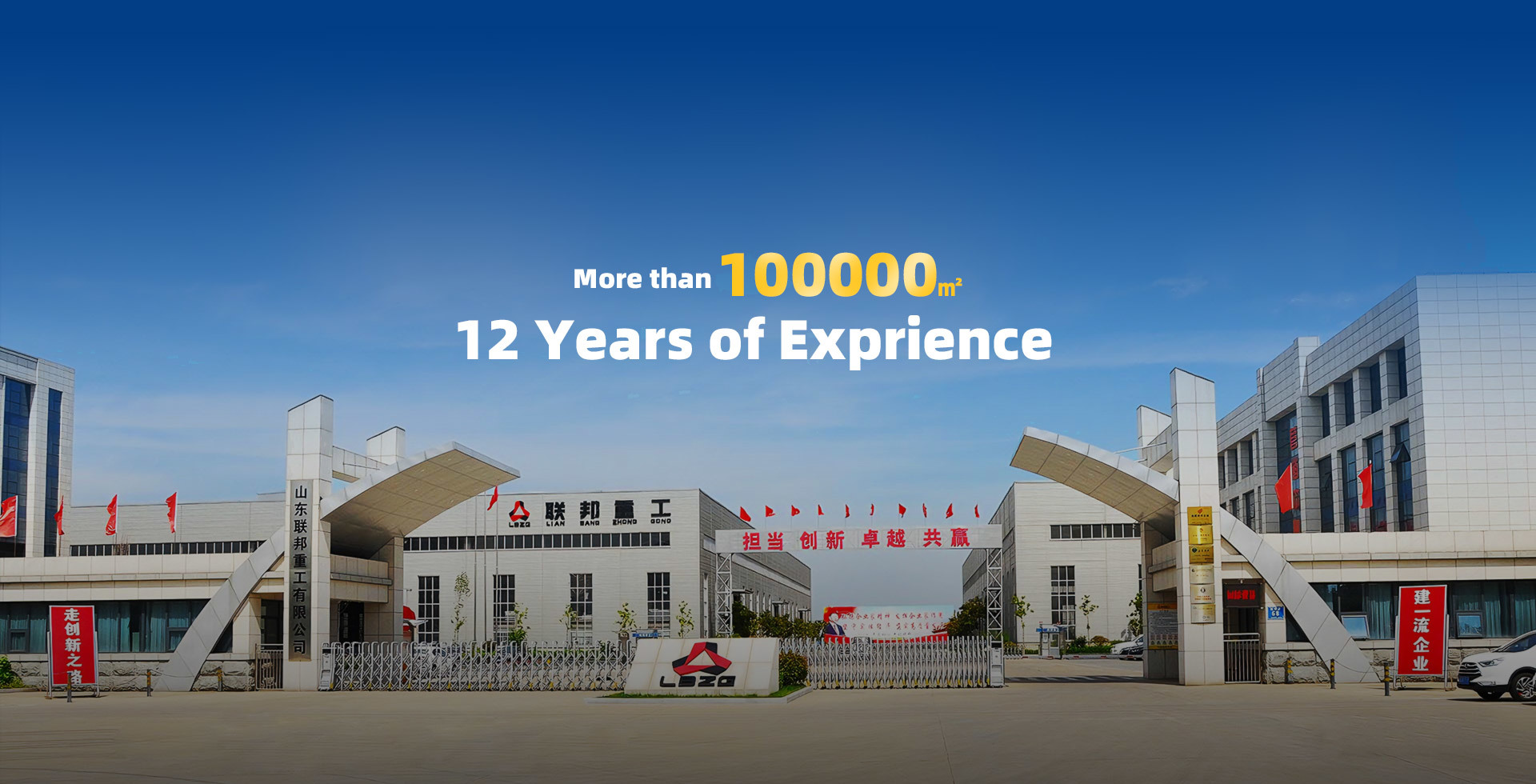
Shandong Lianbang Heavy Industry Co., Ltd. (brand trademark Shanyuan LBZG) is a Chinese manufacturer of sand-stone crushing, sand-making and solid waste recycling equipment that integrates R&D, manufacturing, complete-set EPC solutions and overseas engineering services. The company was registered in 2013, and its technical origins trace back to Chengming Machinery, an affiliated enterprise established in 1996. Its base is at No. 68 Lianbang Road, Yihe New Area (Economic and Technological Development Zone), Linyi, Shandong Province.
Manufacturing scale matters because it determines whether a supplier can build a complete line rather than resell components: LBZG operates two production bases covering a total area of 120,000 m2, including 40,000 m2 of standard workshops, with more than 150 sets of processing equipment installed. The company has around 110 on-the-job employees and more than 40 R&D personnel, a registered capital of 50 million Yuan, and an annual output of about 2,000 units.
Its business modes are sales of standalone equipment, EPC general contracting for complete sand-stone production lines, overall solutions for construction waste and solid-waste treatment, and mobile crushing and screening equipment. Domestically it serves infrastructure projects of central enterprises including China Railway, China State Construction, China Communications Construction and Gezhouba Group, and its products are sold across all provinces and municipalities in China as well as to more than 40 overseas countries. Main markets include the Middle East (Saudi Arabia, the United Arab Emirates, Iraq, Qatar), Central Asia (Russia, Kazakhstan, Uzbekistan), Southeast Asia (Indonesia, Malaysia, Vietnam, the Philippines) and Africa (Nigeria, Kenya, Ghana and other infrastructure-focused countries), with an export ratio of 30%.
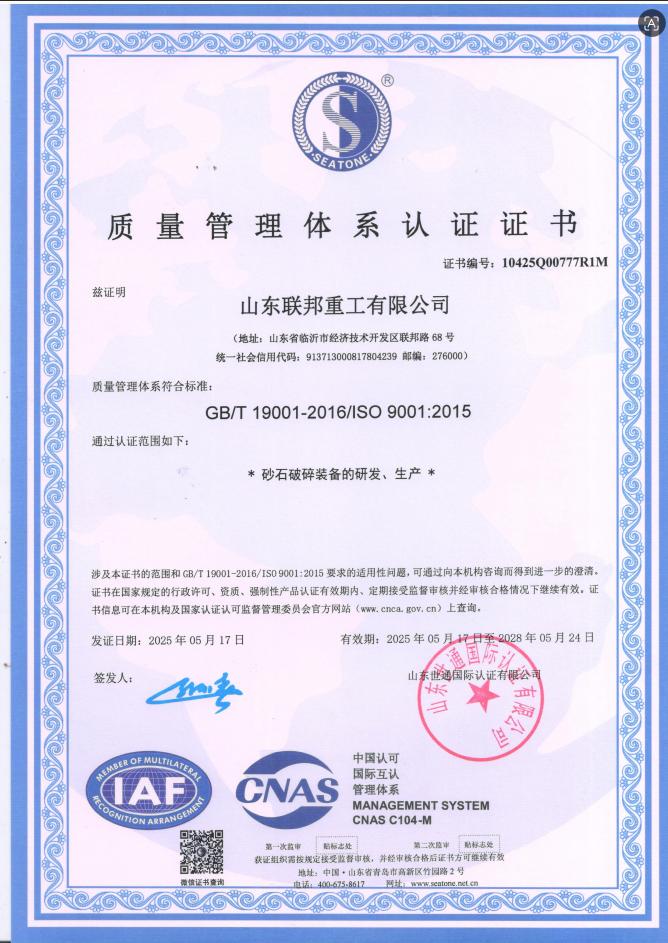
On compliance and technical standing, LBZG holds ISO 9001 quality management system, ISO 14001 environmental management system and OHSAS 18001 occupational health and safety system certifications, plus CE export certification for foreign trade projects. It is a National High-tech Enterprise (re-recognized in 2023), a Shandong Provincial-level Specialized, Refined, Differential & Innovative small and medium-sized enterprise, and a National-level Science-and-Technology-Oriented small and medium-sized enterprise. It participates in revising national industry standards for crushers, and operates a municipal-level engineering laboratory, a municipal-level enterprise technology center and a provincial-level One Enterprise, One Technology R&D center.
How a line is assembled, unit by unit
Feeding. The vibrating feeder is the first control point of the line. ZSW and CZG series feeders deliver stable, continuous feed and can carry a pre-screening function that removes fines before they enter the crusher. A ZSW-490×110 feeder, for example, is rated 80-220 t/h at 15-22 kW with pre-screening, while the larger CZG-1426 is specified for large stone plant feeding and ore pre-screening.
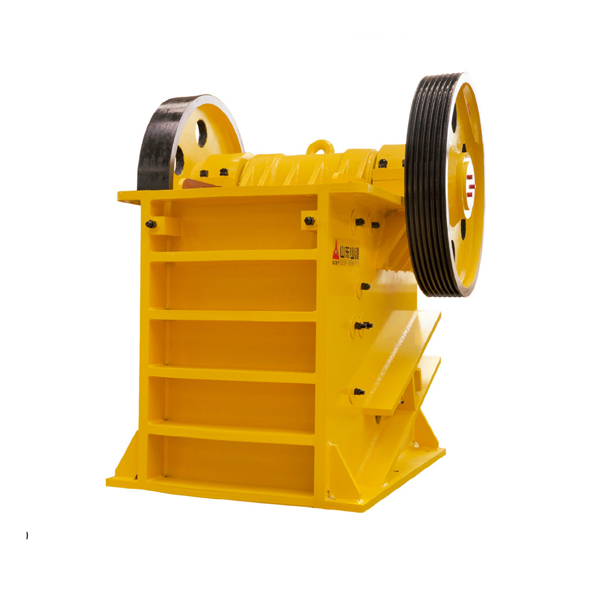
Primary crushing. PE series jaw crushers cover the primary stage from the PE-250×400 (max feed size 210 mm, capacity 5-20 t/h, 15 kW) to the PE-1200×1500 (max feed size 1000 mm, capacity 300-800 t/h, 200 kW). PEX series fine jaw crushers take over secondary and tertiary duty in compact lines, adjusting discharge between roughly 18 mm and 90 mm depending on model.
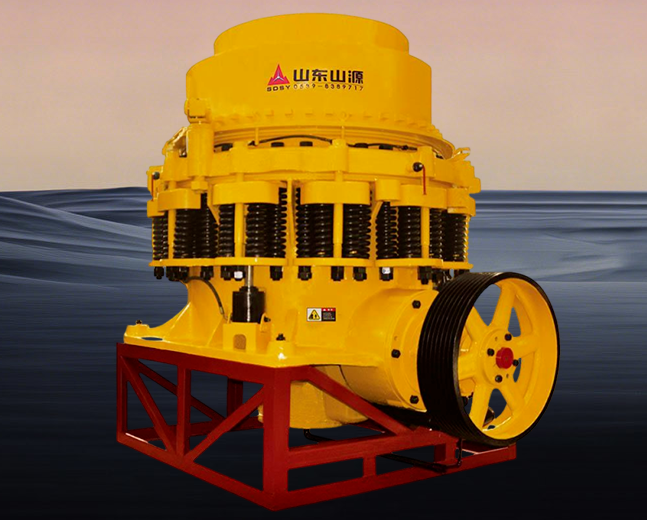
Secondary and tertiary crushing. This is where rock hardness decides the machine. CS hydraulic cone crushers (CS-75 with a 900 mm cone, CS-160 at 1295 mm and CS-220 at 1676 mm, with rated capacities of 45-163 t/h, 109-349 t/h and 181-635 t/h respectively) and PY spring cone crushers (PYB-900 at 50-90 t/h up to PYB-2200 at 590-1000 t/h) handle granite, basalt, quartzite, iron ore and cobble. PF impact crushers such as the PF-1214 (rotor 1250×1400 mm, max feed 400 mm, 80-180 t/h) and PF-1315 (rotor 1320×1500 mm, max feed 500 mm, 100-250 t/h) suit limestone quarries and construction waste. PC and PCX hammer crushers cover fine crushing of limestone, coal, gypsum and shale, from the compact PC-400×300 at 30-50 t/h to the heavy-duty PC-1600×1600 at 500-1000 t/h.
Sand making and shaping. Where manufactured sand is part of the product mix, VSI vertical shaft impact sand makers (VSI-7611 at 110-150 kW and VSI-8518 at 180-220 kW) reshape flaky particles and raise cubical content. PX new-type fine impact crushers serve as an alternative fine crushing and sand-making stage, and the EIS intelligent environmental dry-type sand making system (EIS-1000 with 45 mm maximum feed, EIS-1200 with 50 mm maximum feed and fineness modulus 2.3-3.0) supports dry-process sand production and tailings recycling.
Screening. YK series circular vibrating screens are the grading heart of the line. Two-, three- and four-deck models run from the 2YK-1248 (5.5 kW) through the 2YK-2160 (15 kW) to the 3YK-2470 (22 kW), and screen performance directly determines how much material recirculates back to the crusher.
Conveying. BS belt conveyors move material between stages, with belt widths from B400 (40-80 t/h) to B1200 (650-1200 t/h), and custom lengths available.
Washing and grinding (optional). When the finished product is bound for concrete, asphalt or high-grade mortar and mud content has to stay below about 3%, a washer is added: XSD wheel bucket washers and XS wheel washers for low-clay material, and FG spiral sand washers (FG-500 at 20 t/h up to FG-1200 at 70-110 t/h) for sticky, high-clay feed. For manufactured sand from quartz sand, weathered sand or river pebble, MB rod mills provide the wet grinding stage.
Mobile alternative. YCG tyre-type mobile stations combine the crusher, feeder, screen and belts on one chassis: YCG-J750 mobile jaw (110-230 t/h), YCG-I1214 mobile impact (100-180 t/h), YCG-C160 mobile cone (90-210 t/h), YCG-VSI8518 mobile sand-making (100-180 t/h) and YCG-S2460 mobile screening station (80-300 t/h). They operate on 380V or 440V and are trailer-mounted, so no concrete foundation is needed.
Step-by-Step Breakdown: Configuring a Line Without Overpaying
- Write down the input data first. Rock type, compressive strength and abrasiveness; maximum feed lump size; moisture and clay content; required finished fractions; target tons per hour; site voltage and power availability; whether the site is permanent or moving.
- Size the primary crusher. A practical rule is that the maximum feed lump should be about 0.8-0.85 of the feed opening width, and the rated capacity should sit 10-20% above actual demand so the machine is not run at full load continuously. For a 500 mm limestone feed at roughly 150 t/h, the PE-600×900 jaw crusher (feed opening 600×900 mm, capacity 50-150 t/h, 75 kW) matches without surplus.
- Choose the secondary crusher by hardness, not by price. Granite and basalt typically reach 250-350 MPa and belong in cone crushers, which use lamination crushing with high-manganese or high-chrome crushing walls and iron-pass protection. Limestone typically runs 80-180 MPa and is well served by PF impact crushers when cubical aggregate matters, or by PC/PCX hammer crushers when a high reduction ratio and lower investment matter on low-abrasion, low-moisture feed.
- Match screens and conveyors to the line, not to the crusher. Undersized screening is the most common hidden bottleneck, because unclassified material returns to the crusher and consumes capacity twice.
- Decide whether sand making and washing earn their place. Add a VSI sand maker if 0-5 mm manufactured sand is part of the saleable product; skip it if you only sell coarse and medium aggregate. Add a washer only when mud content requirements justify the water and fine-material losses.
- Check compliance and site conditions. Confirm voltage adaptation (380V, 440V, 415V or 660V), climate package for tropical, arid or high-altitude sites, dust suppression, and the language of manuals and spare-parts lists.
- Validate before you commit. Test-crush a material sample to confirm product shape, fines content and wear-part consumption before the model list is frozen.
| Unit | Matching rule |
|---|---|
| Vibrating feeder | 1.1-1.2 × the rated capacity of the primary jaw crusher |
| Secondary crusher | 1.0-1.1 × the actual output of the primary stage |
| Vibrating screen | 1.2-1.3 × line capacity |
| Belt conveyor | 1.2 × maximum material flow |
| Target operating load | Keep each unit at 70-90% of rated load to control energy use and wear |
Two worked configurations
Limestone line at about 150 t/h. ZSW-590×110 vibrating feeder (160-350 t/h) feeding a PE-600×900 jaw crusher (50-150 t/h, 75 kW), followed by a PF-1214 impact crusher (80-180 t/h, 132-160 kW), a 2YK-1854 circular vibrating screen and a B650 belt conveyor (80-200 t/h). If silica content is high or measured hardness exceeds roughly 200 MPa, the secondary stage should move to a PF impact crusher with a tougher blow bar specification or to a CS/PY cone crusher.
Granite or basalt line at 150-250 t/h. PE-750×1060 jaw crusher (100-180 t/h, 110 kW) for primary crushing, CS-160 hydraulic cone crusher for secondary and tertiary duty (fine cavity 109-181 t/h, medium 132-253 t/h, coarse 172-349 t/h), VSI-8518 for shaping and sand making, and a 2YK-2160 screen. For an 80-150 t/h hard rock line, the PE-600×900 jaw with a PYB-1200 spring cone crusher is the lower-investment route. What should not be done is to put an impact crusher in hard rock secondary duty to save initial investment - blow bar wear raises the cost per ton far more than the purchase saving.
Use Cases: Where These Lines Are Deployed
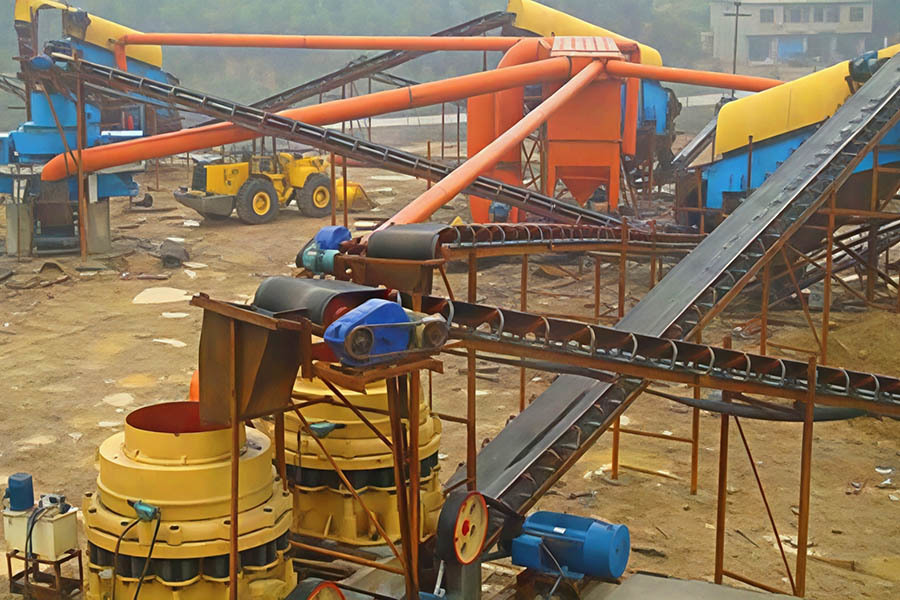
High-speed railway and infrastructure aggregate. The Lunan High-Speed Railway project is an official reference project, producing railway ballast and high-strength concrete aggregate plus manufactured sand for subgrade and sleeper concrete. Working conditions are 24/7 continuous production in an open-pit quarry with dust and high-abrasion material; the line uses feeder, screens, belt conveyors, secondary crusher, dust-removal system, spare wear parts and a centralized control system, and must hold a cubic particle shape with fineness modulus compliance in the 2.3-3.0 band.
Hydropower and water conservancy. Dam construction needs high-strength concrete aggregate and manufactured sand for mass concrete, produced over multi-year continuous operation, often at high-altitude or remote sites. Wear-resistant crushing chambers and remote-site serviceability are the selection drivers.
Overseas quarry and Belt and Road infrastructure projects. These lines are specified for tropical, arid or high-altitude climates and for grid variation, with adaptation to local voltage (380V, 440V, 415V or 660V), multilingual manuals, a spare parts kit and long-distance service support. This is the scenario where documentation quality and spare-parts logistics decide whether the line reaches rated output.
Construction and demolition waste recovery. Trailer-mounted mobile operation with on-site zero-transport processing, low noise and low dust emission: outputs are recycled aggregate, recycled concrete bricks, recycled dry powder slurry and recycled soil, with a magnetic separator and dust-removal system in the flow.
New town and airport construction. Large-volume aggregate and manufactured sand for municipal concrete and airport runway works, with airport-grade aggregate specification, dust suppression, and mobile backup for multi-site projects.
Solid and hazardous waste treatment. Sealed enclosure with negative-pressure dust collection, corrosion-resistant materials and an explosion-proof motor option support waste volume reduction and closed-loop material circulation.
Fixed Line or Mobile Crushing Station?
| Decision factor | Fixed crushing line | YCG mobile crushing station |
|---|---|---|
| Project duration | Long-term stable quarry, generally more than 3 years | Short duration, generally under 2 years |
| Site relocation | Site stays in place | Frequent relocation between job sites; tows as a whole |
| Capacity | Large-scale, above about 300 t/h | Single-unit capacity is usually lower than a fixed line |
| Foundation and civil works | Requires land, foundations and a longer construction period | Trailer-mounted, no concrete foundation, short installation and commissioning time |
| Cost structure | Lower per-ton operating cost | Lower civil cost, but higher diesel and tyre costs |
| Typical models | PE/PEX jaw, CS/PY cone, PF impact, PC/PCX hammer, YK screens, BS conveyors | YCG-J750 (110-230 t/h), YCG-I1214 (100-180 t/h), YCG-C160 (90-210 t/h), YCG-VSI8518 (100-180 t/h), YCG-S2460 screening (80-300 t/h) |
Comparison Table: Which Crusher Belongs at Which Stage
| Crusher family | Typical models | Max feed size | Rated capacity | Stage in the line | Best-fit material |
|---|---|---|---|---|---|
| PE primary jaw | PE-250×400 to PE-1200×1500 | 210 mm to 1000 mm | 5-20 t/h to 300-800 t/h | Primary | Quarry rock, mining feed and construction waste of all hardness up to about 320 MPa |
| PEX fine jaw | PEX-150×750 to PEX-300×1300 | 120-250 mm | Discharge adjustable 18-90 mm | Secondary / tertiary (compact plants) | Mining, metallurgy, building material, road and bridge aggregate |
| PF impact crusher | PF-1214, PF-1315 | 400 mm, 500 mm | 80-180 t/h, 100-250 t/h | Secondary | Limestone quarry and construction waste; cubical product shape |
| CS hydraulic cone | CS-75, CS-160, CS-220 | Cone 900 / 1295 / 1676 mm | 45-163 / 109-349 / 181-635 t/h | Secondary / tertiary | Granite, basalt, quartzite, iron ore, cobble |
| PY spring cone | PYB-900 to PYB-2200 | Feed opening 115-300 mm | 50-90 t/h to 590-1000 t/h | Secondary | Granite, basalt, quartzite and ore medium-fine crushing |
| PC / PCX hammer | PC-400×300 to PC-1600×1600; PCX-0808 to PCX-1822 | Up to 450 mm (PC-1000 box type) | 30-50 t/h to 500-1000 t/h | Fine / tertiary crushing | Limestone, coal, gypsum, shale and medium-hard brittle materials |
| VSI / PX sand maker | VSI-7611, VSI-8518; PX-800 to PX-1822 | 35 mm (soft) / 30 mm (hard) for VSI-7611 | PX-800 at 30-45 t/h to PX-1822 at 210-270 t/h | Tertiary, shaping and sand making | Artificial sand production and particle reshaping |
Reading the table correctly: crushers are not interchangeable across stages. A cone crusher is not a primary crusher because its feed opening limits the lump size it can accept, and a jaw crusher cannot produce finished 0-5 mm sand on its own. Stage assignment comes before model comparison.
What to Check When Shortlisting a Stone Crushing Production Line Manufacturer
Because the HVQ that brings most buyers to this page is supplier discovery, these are the checks that separate a line supplier from a machine trader.
- Line-level engineering, not catalogue assembly. Can the supplier offer EPC general contracting for a complete sand-stone production line, or only standalone equipment? A line supplier must be able to size the whole circuit, not just quote a crusher.
- In-house manufacturing footprint. Production base area, standard workshops, installed processing equipment and the size of the R&D team indicate whether the supplier actually manufactures the frame and wear parts it sells.
- Certification and standards position. Look for ISO 9001 (quality), ISO 14001 (environment) and OHSAS 18001 (occupational health and safety) system certification, plus CE export certification where the destination market requires it. For mobile equipment, ISO 21873-2:2019 is the relevant safety standard. Participation in revising national industry standards for crushers is a useful indicator of technical standing.
- Reference projects that match your application. Railway ballast, hydropower aggregate, overseas quarry and construction waste recycling each stress a line differently. Ask for references in your own application, not the largest number of references.
- Adaptation capability. Voltage variants, climate packages, multilingual manuals and an overseas service network matter more than a small price difference once the line is running abroad.
- Wear parts and spares policy. Confirm which materials are offered for jaw plates, blow bars, hammers and liners, what the expected service life is under your rock, and how original spares are supplied.
- Sizing support. A serious supplier will size models from your rock sample data and feed size distribution rather than from a sales target.
Frequently Asked Questions
What certifications and standards should I verify before importing a complete stone crushing production line?
Confirm that the manufacturer holds ISO 9001 quality management system certification, and check the environmental and safety system certificates as well - ISO 14001 and OHSAS 18001 are commonly required in project tenders. For mobile crushing equipment, the relevant safety standard is ISO 21873-2:2019, which specifies safety requirements and verification for mobile crushers used to crush rock or reprocess construction materials. Destination-market requirements apply on top of these; CE documentation is the common case for European projects. Beyond certificates, request material and welding inspection reports, factory test-run videos, full English technical documentation (manuals, drawings, spare-parts lists) and sea-worthy packing and shipping documents, because these are what allow customs clearance and local project acceptance. LBZG holds ISO 9001, ISO 14001 and OHSAS 18001 certifications plus CE export certification for foreign trade projects, and participates in revising national industry standards for crushers.
How do I choose between jaw, cone and impact crushers for granite, basalt or limestone?
Choose by stage and by hardness. The primary stage is almost always a PE series jaw crusher, which handles coarse crushing of materials of all hardness levels up to roughly 320 MPa and accepts large feed sizes. For secondary and tertiary duty, granite and basalt typically have compressive strengths of 250-350 MPa and are highly abrasive, so the recommendation is a cone crusher - CS hydraulic or PY spring - because lamination crushing with high-manganese or high-chrome crushing walls lasts far longer than impact crusher blow bars under that duty. Limestone is medium-soft at roughly 80-180 MPa and suits a PF impact crusher when cubical aggregate for concrete or asphalt matters, or a PC/PCX hammer crusher when a high reduction ratio and lower investment are the priority on low-abrasion, low-moisture feed. If manufactured sand is required, add a VSI sand maker for shaping rather than trying to force the required fineness modulus out of the secondary crusher.
What actually drives the cost of a stone crushing production line?
Six factors dominate. First, target capacity: tonnage drives crusher size, screen area and belt width, so a 300 t/h line is not a 150 t/h line with a bigger jaw. Second, rock hardness: hard rock pushes the secondary stage toward cone crushers, and although the initial investment is higher - cone crusher initial investment is typically 30-50% above an impact crusher at comparable duty, and at equal capacity a jaw crusher costs roughly 60-70% of a comparable cone crusher - cone liners last six to twelve months against three to six months for jaw plates, so the gap narrows over two to three years of operation. Third, whether the scope includes sand making and washing stages, which add equipment, water and power. Fourth, wear-part material selection, which sets the recurring cost rather than the purchase price. Fifth, civil works and power: a jaw crusher needs only a simple foundation while a cone crusher needs an elevated platform. Sixth, mobile versus fixed, since tyre-mounted stations trade a higher cost per ton for zero foundation work and fast relocation.
Can I test the line before ordering, and how do I get a configuration and quotation?
Yes. Material testing is the standard de-risking step: send a sample of roughly 50 kg of your rock for test crushing, and the results are used to verify product shape, fines content and wear-part consumption before the model list is finalised. Suppliers with EPC capability will then build the process flow around your target finished-product fractions, your feed size distribution and your site conditions, and can quote either the complete line or individual units. For a configuration check, share the rock type and compressive strength, maximum feed lump, target tons per hour, required output fractions and site voltage with the LBZG team at lbzg@lbcrusher.com or on WhatsApp at +86 139 5388 7097, and download the full product and capability brochure for line-by-line specifications.
Conclusion
A stone crushing production line succeeds or fails on matching, not on the size of any single machine. Fix the input data first, assign the correct crusher to each stage by rock hardness, size the feeder, screens and conveyors against the line rather than the crusher, and decide deliberately whether sand-making and washing belong in the scope. Those four decisions account for most of the difference between a line that reaches its rated output and one that never does.
Shandong Lianbang Heavy Industry Co., Ltd. (Shanyuan LBZG) builds that scope as a single responsibility, from standalone equipment through EPC general contracting for complete sand-stone production lines, mobile crushing and screening stations, and construction waste and solid-waste treatment solutions - supported by ISO 9001, ISO 14001, OHSAS 18001 and CE certification, a 120,000 m2 production base and service coverage in more than 40 countries.
Next step: validate your line before you buy it
Send a rock sample for test crushing, or request a line configuration and quotation based on your feed size, target tons per hour and finished-product fractions. Typical request includes: material type, compressive strength, maximum feed lump, required output fractions, site voltage and whether the site is fixed or moving.
Email: lbzg@lbcrusher.com | WhatsApp: +86 139 5388 7097 | Website: www.sypsj.cn
Download the company and product brochure: Shandong Lianbang Heavy Industry brochure (PDF)
Have Questions or Need More Details?
Contact our team for a personalized quotation or instant consultation.
Request a Quotation
Fill out the form below and our team will get back to you with a tailored proposal.
WhatsApp Direct Chat
Prefer to chat in real-time? Message us on WhatsApp for instant assistance & quick answers.
- Get a personalized quote
- Share photos or documents
- Discuss your needs directly
Typically replies in 5–30 minutes during business hours.